SWIMS October Newsletter 2026
soaringwings2026-10-05T10:21:39-06:00October
7…MONT101 9:00 – 10:00am. If you’re new to Montessori or just have questions or ideas, please join school leaders for a discussion on what the Montessori Method is all about! Please respond to duna@soaringwings.org with the number in your party. Adults only, please.
7…Happy Birthday, Norma!
11…Happy Birthday, Vung!
14…Half Day!
11:30 – 11:45 dismissal for Bumblebees & Sunflowers Toddler Classes, Turquoise & Ladybugs Early Childhood Classes.
11:45 – noon dismissal for Ducklings & Owlets Infant Class, Chickadees & Tadpoles Toddler Classes, Bluebirds Early Childhood Classes, Wasatch & Evergreen Elementary & Bridgemont Secondary Classes.
15-16…Fall Break! No School
9 & 23…Parent Conferences – No School. See the sign-up link emailed 10/1. Please arrange with families scheduled before or after your conference to supervise children in the hall.
23…Happy Birthday, Nathy!
24…Happy Birthday, Millie!
30…Party Day for all classes! Regular schedule. Teachers will follow with details. Costumes welcome! No candy, nuts, weapons, bloody or grotesque costumes, please. See class sign-ups for needed supplies.
November
20…Half Day & Feast Day!
11:30 – 11:45 dismissal for Bumblebees & Sunflowers Toddler Classes, Turquoise & Ladybugs Early Childhood Classes.
11:45 – noon dismissal for Ducklings & Owlets Infant Class, Chickadees & Tadpoles Toddler Classes, Bluebirds Early Childhood Classes and Wasatch & Evergreen Elementary & Bridgemont Secondary Classes.
23…Happy Birthday, Annie!
24…Happy Birthday, Nicole!
23 – 27…Thanksgiving Break – No School
27…Happy Birthday, Sarah!
30…Angel Trees ->December 7
From the Administrator's Desk
Learning to Be Human
by Leith Strachan, MBC
Our children are growing up at the beginning of an extraordinary technological shift. Artificial intelligence will likely be woven into nearly every part of their adult lives. That makes the Elementary years perhaps one of our last protected opportunities to give children something increasingly rare:
The experience of learning from another human being, face to face.
One of the great promises of AI-based education is personalization—the ability to recognize what a child needs and deliver the right lesson at exactly the right time. That’s powerful. But it’s also exactly what a trained Montessori teacher has always been taught to do for over a century.
A Montessori teacher observes each child, understands where they are academically and developmentally, and introduces the next lesson when that individual child is ready.
The difference is that the teacher sees more than the data. They see hesitation, frustration, excitement, distraction, and fear of failure. They know when to intervene, when to ask another question, and when to step back and let the child struggle a bit.
An AI may become extraordinarily good at determining what a child needs and when they need it. A great teacher can do that while also understanding the person who needs it. That matters because the human interaction isn’t separate from the academic lesson. It is part of the academic lesson.
When children learn mathematics, language, science, and history from other people, they are also learning to ask questions, explain their thinking, listen, accept correction, persevere through frustration, and discover things alongside another human being. And we believe that matters not only for the individual child, but for society as a whole.
Education isn’t simply about transferring information. We are preparing children to become neighbors, colleagues, parents, leaders, and members of communities. We don’t believe outsourcing the academic education of children to computers ultimately serves that larger purpose.
Technology absolutely belongs in education. Our children must learn how to use it thoughtfully and responsibly. But there is an important difference between learning with technology and outsourcing learning to technology.
Our children will have the rest of their lives to interact with increasingly capable machines.
Childhood is brief.
Before we launch them into an increasingly digital world, we want to give them every opportunity to learn what it means to be human.
Technology is an incredible tool. But nothing can replace a great teacher
Lowdown from Lower School: Infant, Toddler and Early Childhood News
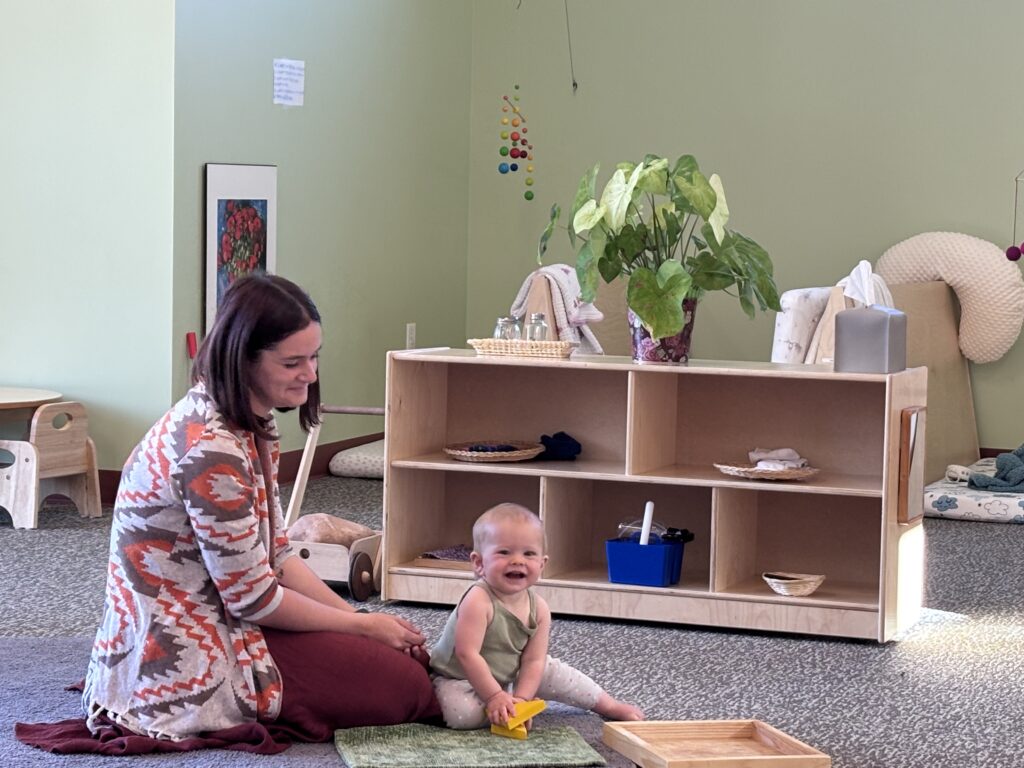
Infant & Toddler Impressions – Notes from Ducklings, Owlets, Bumblebees, Chickadees, Sunflowers and Tadpoles Classes
October brings the 6th week of the new school year and normalization! This is traditionally the time when students have settled into the routine and are feeling comfortable in the school environment. They have by now learned to wash hands, those who can walk (and even some who can’t!) are setting places for snack and lunch, clearing places and washing their dishes. They are working on blowing noses, keeping faces clean and getting in and out of the bathroom successfully. All of this self care brings the joy of independence as children realize how much they can do for themselves. Take a look at how teachers do this in class and think about how to set up your home for your child’s success. By placing low hooks and child-sized seating by the door your child can dress and undress for the weather. A small table and chair in the kitchen and a low cupboard where your child can access eating utensils and acceptable snacks allow your child to prepare breakfast, lunch or a snack when hungry. Also supply a small broom and dust pan, small sponge and spray bottle and your child can clean their dining space.
We have introduced the primary colors and will begin blending red, yellow and blue paint this month. As we get better at controlling drips we will move from finger paint and tempera paint with large brushes, to liquid water colors with small brushes.
Simple science experiments are being introduced such as sink and float, magnetic and non-magnetic and the properties of water.
As the leaves change around us we will notice the signs of the new season – fall. This takes us into trying on hats and masks in preparation for Halloween so these youngest students can see that even with a mask on, it’s still the same person underneath. We will focus on what is real in celebrating Halloween – cats, bats, pumpkins and spiders – creating crafts to decorate the classrooms so students take part in making the room spooky in time for Halloween parties. There will be special snacks, crafts, stories and a dance party on the 30th. Check with teachers for what is needed!
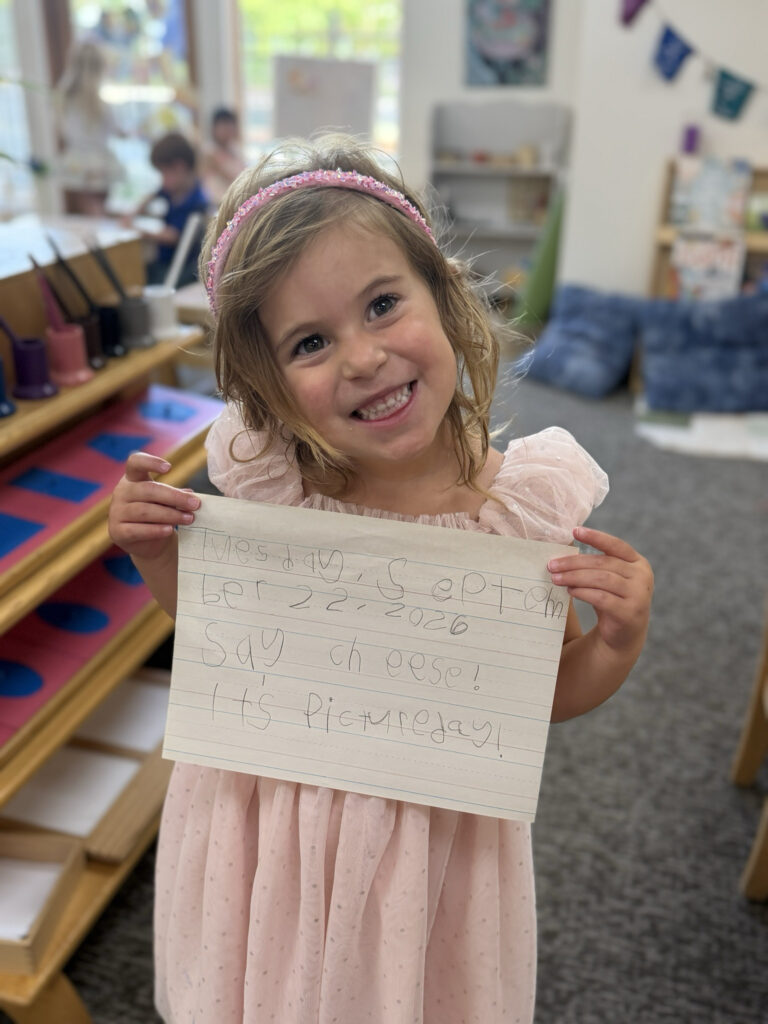
Every Day in Early Childhood – Events in the Bluebirds, Ladybugs & Turquoise Classes
Daily lessons include exercises in Practical Life, Sensorial, Math and Language as well as Science, Art, Music, History and Geography. Every student assimilates the hundreds of lessons in the ec curriculum at their own pace. By their 3rd year in ec students are feeling the confidence of knowing they are able to polish off the big lessons all by themselves, such as creating stories with the class farm.
In October we are finishing the Art History Timeline that gave us a peek into Early Art, Egyptian Art, Roman Art and Renaissance Art. From the earliest cave paintings 40,000 years ago people were leaving their stories for us to find on walls, tombs, pyramids, sarcophagi and mosaics. With the invention of books came less attention on story telling in art and more attention on portraits. With the invention of the camera there was no longer a need to capture images on canvas and artists began the experimentation of the Impressionists and Modern Artists. With each chapter students try their hand at a different style of art. You will see their self-portraits soon.
We complete our study of fall in time to begin our Explorer Timeline that takes a look at the initial exploration of the world, Indigenous Peoples in general, and the Wampanoags, in particular. This story builds through November with students taking part in adding each chapter in time for our Thanksgiving Feast on November 20th.
Our study of the Earth and its basic land and water forms continues through October leading up to the introduction of the globe and map with students taking turns identifying the islands, lakes, bays, capes, gulfs, peninsulas, isthmuses and straits on the globe. They often recreate the basic landforms in the sand on the playground. The next time you are playing in the sand, challenge your ec students to see how many landforms they can create!
Botany lessons cover seeds, needs and edible parts of a plant in time to begin chopping vegetables for Stone Soup for our feasts.
Authors Anno and Tomie DePaola add to the threads weaving together to produce a tapestry of where North America is on the globe and the cultures that have made their homes here.
Ask your ec students about these topics and see what they remember from the daily lessons. You might get them started by dialing up the old Donovan song, “Happiness Runs” which is what we sing as we begin circle every day.
What’s Up in the Upper School: Elementary, Middle and High School
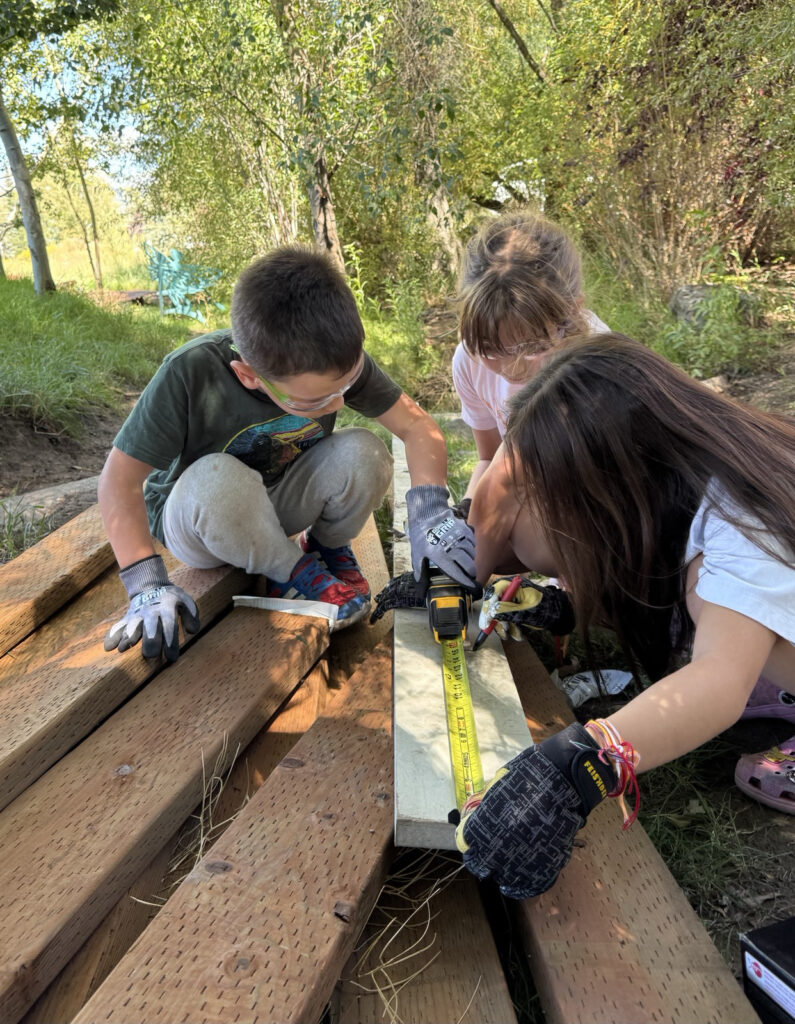
Elements of Elementary and Middle School with High School Highlights – News from the Wasatch & Evergreen Elementary & Bridgemont Secondary School Classes
In October the theme of Indigenous Peoples resonates through every classroom right up into the Upper School where the big kids often take the lead in our relationship with our “adopted” Navajo Grandma Frances. She turned 100 in September, and her family has taken her “back to the land” to her home in northern Arizona. Our students made 100 hearts for her and we sent them to her along with a few gifts. Although she hasn’t visited in years Grandma Frances’ portrait is in every classroom along with the gifts she has given us over the years – Navajo skirts, dolls, rugs, jewelry and her loving Dine’ spirit. This month we will take a look at a variety of Indigenous Peoples contributing to all parts of our curriculum.
Upper School classes are completing the Great Lessons that begin the study of how our planet and cultures came to be. They are finishing up game skills and team building while the weather is warm and planning the year’s Friday field trips and excursions. These students run their own meetings and plan their own curriculum around their class time spent practicing academics at their own individual level. Those who need a little extra time on a concept can work on it in a variety of ways to bring understanding. Those who have mastered the current material move ahead. This mastery learning has much to do with the phenomenal test scores we see from Bridgemont as well as the building of intrinsic motivation.
Weekly field trips allow students to confirm in the real world what they have learned in class. They recently visited the Clark Planetarium bringing together all the science, history and functional geography they have learned from the Great Lessons. Then they brought those lessons home with hike up PC Hill and a timeline of how our town has changed since the mastodons roamed here. And these industrious Upper School students are already working on a script for this year’s all-school play for our Winter Celebration.
The Montessori approach to learning including mastery learning, uninterrupted work periods and allowing students to plan their own curricula to include their own interests as well as required components, results in a remarkable group of peaceful, joyous learners and explorers of the world. With our school bus ready to go anywhere, everything is possible. This group of elementary, middle and high school students lives up to their motto established by Bruce’s first elementary class – “We work harder and play harder, too!”